

Before we get into specific ways to implement small group ministry, let’s begin with God’s priorities!
From the House to House book chapter 3
by Larry Kreider
It is our natural tendency to look for formulas and methods to fulfill the Lord’s plans. However, the more we grow in the Lord, the more we realize the way we think with our natural minds is often not at all what the Lord has in mind. So before we get into specific ways to implement small group ministry, let’s begin with God’s priorities.
Ecclesiastes 4:12 tells us, “A cord of three strands is not quickly broken.” The three strands that form the core of the Christian life are prayer (knowing God), evangelism (reaching those who do not know Jesus), and discipleship (training new believers).
Prayer: Knowing God
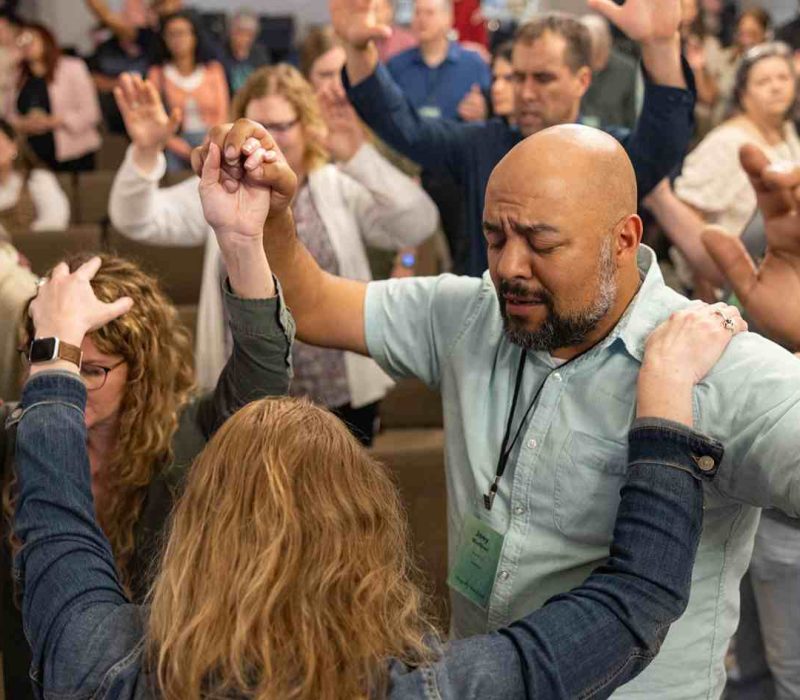
God has called us, first and foremost, to trust Him! Matthew 28 tells us Jesus appointed a certain place to meet with His disciples. And when they saw Him, they worshiped Him.
Then the eleven disciples went to Galilee, to the mountain where Jesus had told them to go. When they saw Him, they worshiped Him; but some doubted. Then Jesus came to them and said, “All authority in heaven and on earth has been given to Me. Therefore go and make disciples of all nations, baptizing them in the name of the Father and of the Son and of the Holy Spirit, and teaching them to obey everything I have commanded you. And surely I am with you always, to the very end of the age” (Matthew 28:18-20).
Jesus has called us to meet with Him and worship Him each day. The Lord tells us in John 17:3 that eternal life is to know Him. Our number-one priority must be to spend time with Him each day, If we do not put Jesus first, our small group ministry or any other ministry will become just another church program.
Often when speaking at churches and conferences, my wife, LaVerne, does not travel with me. When on those trips, I find great joy in searching through my luggage for a special love note she has hidden in my bags. I love reading those notes, because I’m in love with her. If I no longer desired to read those notes, it would be a warning light that my love for her is waning. Do you look forward to reading your love letters from Jesus? That is what the Bible is full of; love letters from the God who loves us.
Jesus says in Matthew 4:4, “Man does not live on bread alone, but on every word that comes from the mouth of God.” I need a fresh word from the Lord every day. If I am living on last week’s manna, I will begin to get weak and even sick spiritually. Only healthy Christians will have something to give to others. There is no substitute for fellowship with God in prayer and His Word. We must cultivate our relationship with our Lord Jesus every day.
If your prayer life needs a boost, I encourage you to read my book entitled Your Personal House of Prayer1 and experience an extreme makeover for your prayer life!1 The God-given principles in this book have radically changed my personal prayer life.
Evangelism: Reaching those who do not know Jesus
Jesus spent much of His time with the tax collectors and the sinners of His day. His heart went out to those who did not live the way God wanted them to. The people who hated Jesus were not the sinners but the religious leaders. We need to be careful not to focus more on church politics, personal opinions, and self-preservation than on the priorities of Jesus.
The Bible says, “The reason the Son of God appeared was to destroy the devil’s work” (1 John 3:8). The works of the devil are everywhere. Our communities are filled with broken lives, fear, abuse, perversion, the murdering of unborn children, immorality, materialism, and lust. Jesus came to destroy these works!
Our heart motivation for being involved in ministry must be the same as that of our Lord Jesus: to destroy the works of the devil. Jesus is the answer to every problem. He is the great Redeemer. He came to completely restore every man, woman, and child. The Scriptures tell us, “How can they believe in the one of whom they have not heard?” (Romans 10:14). We are commissioned by our Lord Jesus Christ to reach those who have not placed their trust in Him. Small groups and micro churches are among the tools we can use to fulfill this mandate.
Jesus told His disciples in Matthew 28 “Go,” knowing that all authority had been given to Him in heaven and on earth. He promised to be with them always, just as He will always be with us. Often Christians do not sense the Lord’s presence with them. Could it be they are so caught up in the cares of this world that they feel unable to obey the commandment to go and share Jesus with those who have not yet believed in Him?
Discipleship: Training new believers
Jesus commands us in Matthew 28:19-20 to “go and make disciples of all nations, baptizing them in the name of the Father and of the Son and of the Holy Spirit, and teaching them to obey everything I have commanded you.” Unless we have a clear understanding making disciples is near the top of God’s priority list, ministry will be just another religious program.
Jesus had a vision to revolutionize the world—person to person, and house to house. Out of the multitudes of His followers, He appointed only twelve to be His disciples, designating them apostles, that they might be with Him and He might send them out to preach (see Mark 3:14). He took special time with three of them: Peter, James, and John. John was clearly the disciple whom Jesus loved.
By living closely with His disciples, day in and day out, Jesus gave them intense training, demonstrated His miraculous power, explained His parables, and answered their questions.
A disciple is a learner or an apprentice. Jesus provided His disciples with innumerable opportunities to practice and exercise the things He taught them. He poured His life into them by close, daily contact for three years. As we observe Jesus interacting with these twelve men, we see a model of what could be regarded as the first small group in the history of the church.
The Lord commands us to go and do likewise. Whatever He has taught us, we are to teach to others. This not only applies to Bible knowledge but to practical Christianity. The most effective way for you to teach a young husband how to love and honor his wife is for you to love and honor your wife. The best way for you to teach another Christian how to have a clear financial budget is for you to show him how you set up a budget. If you believe the Lord has called you to teach a new Christian to pray, then pray with him! We teach others by modeling biblical truths with our own lives.
The Bible gives many examples of discipleship. Paul the apostle took young Timothy with him as a disciple (see Acts 16). Later, Timothy was sent out to do the same: take the truths he learned from Paul and impart them to others (see 2 Timothy 2:2). Moses had Joshua as his disciple for forty years, preparing Joshua for leadership. Elijah found Elisha and became his mentor. The list goes on and on. The Lord is restoring the truth of loving discipleship to His church today. He has called us to make disciples.
We often call this “spiritual parenting.” God’s intention is to raise up spiritual parents who are willing to nurture spiritual children and help them grow up in their Christian lives. In this way they are making a spiritual investment as they see others’ potential in Christ and make themselves available to discipling them. This is a fulfillment of the Lord’s promise to “turn the hearts of the fathers to the children, and the hearts of the children to their fathers” (Malachi 4:6). Spiritual children need to have spiritual parents in their lives who will demonstrate godly character and tell them they are valuable gifts from God.
In my book The Cry for Spiritual Fathers and Mothers, I reveal what happens when spiritual parenting does not take place. I explain that too often, in today’s church, a Christian believer is encouraged to participate in church services, Bible studies, or evangelistic ministry in order to “grow strong in the Lord.” The theory is that the more teaching from God’s Word and interaction with believers, the more spiritually mature he will become. As important as these may be, such a faulty supposition leads one to inhale message after message and book after book in order to fill a void for real relationship.
A believer becomes fat spiritually and fails to interpret what he is learning so he can pass it on to others. He does not know how to meaningfully and sacrificially impart his life to others because he has never been properly fathered. Without a role model, he remains a spiritual infant, needing to be spoon-fed by his pastor or another Christian worker.3
Christianity is not just sitting on a padded chair each Sunday morning, looking at the back of someone’s head. Christianity is trusting Jesus, reaching out to pre-Christians, and making disciples. This must be the motivation of our hearts in order to effectively fulfill the Lord’s purposes. You will discover the three strands of prayer, evangelism, and discipleship surfacing again and again in these pages.
How are these priorities expressed in different church structures today? What kinds of churches does God use to fulfill His purposes?
More about building with small groups
Updated for a new generation: House to House book by Larry Kreider available in book, eBook or audiobook format